Poetry
Inventory of the Alchemist
The alchemist abandons perfection and discovers a harder transformation: letting matter—and the self—become something new without calling it gold.
R
Richard Nkwenti
2 min read
At the end of the season, the alchemist
records what the work has cost.
Not gold. Gold was the rumor
that brought impatient patrons to the table.
The true ledger is stranger.
Three copper bowls thinned by salt.
A sleeve burned through at the wrist.
Seven months given to a substance
that remained stubbornly itself.
One friendship corroded by secrecy.
Sleep, in quantities impossible to recover.
On the shelves: sulfur, iron, vinegar, bone ash,
a blue mineral ground fine as dusk.
Nothing mystical when named alone.
Together, under heat, each becomes capable
of betraying its ordinary nature.
This is why transformation attracts the lonely.
It suggests the unloved element
may be one procedure away from radiance.
Apply flame. Remove impurity.
Repeat until worthy.
But matter resists the insult.
Lead is not failed gold.
Salt does not apologize for refusing sweetness.
The black stage of the work—nigredo—
is not punishment.
It is the moment appearances can no longer
protect the false theory.
Near midnight, the furnace quiets.
The alchemist opens every shutter
and lets cold air discipline the smoke.
For the first time, the ruined experiments
are not hidden before morning.
Cracked glass catches moonlight.
A useless red powder glows beautifully
without becoming valuable.
The inventory continues.
What was learned from failure.
What was lost to obsession.
Which desires belonged to the work
and which were borrowed from those
who promised love in exchange for astonishment.
At the bottom of the page,
there should be a conclusion.
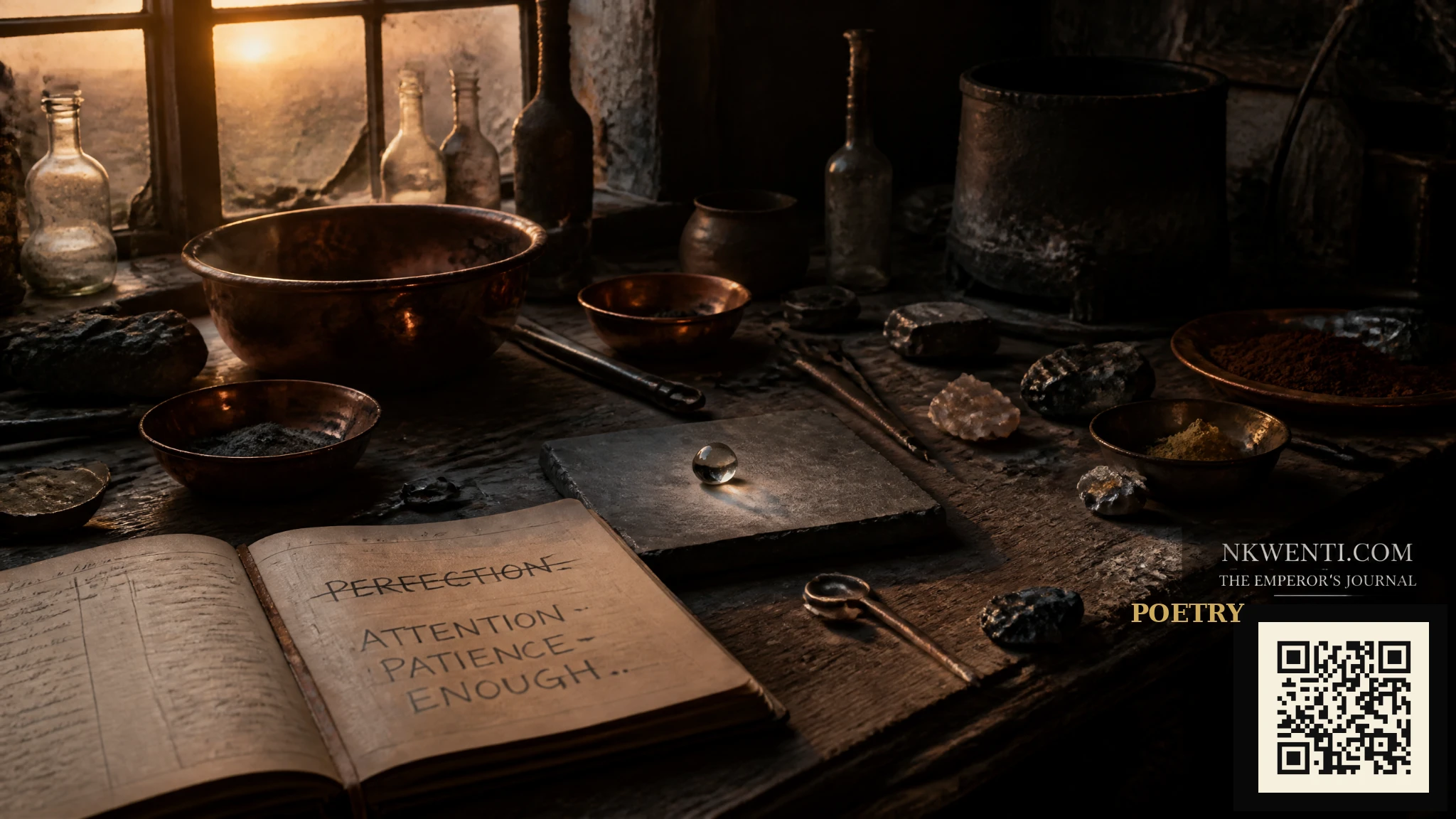
Instead, a line is drawn through the word perfection.
Beneath it: attention.
Beneath attention: patience.
Then, after a long pause, enough.
Dawn finds the laboratory unchanged—
stone, metal, soot, the mortal body among them.
No coins spill from the crucible.
No angel speaks from vapor.
Yet on the cooling tray
rests a bead of unfamiliar glass,
dark at its center, clear at the rim.
The alchemist does not name it success.
Names have spoiled enough experiments.
It is lifted toward the window
and allowed to be what it is:
not gold,
not failure,
a small new substance
that can finally survive the light.