The People We Outgrow
Not everyone we lose was meant to be lost. Some people simply belonged to a version of us that no longer exists.
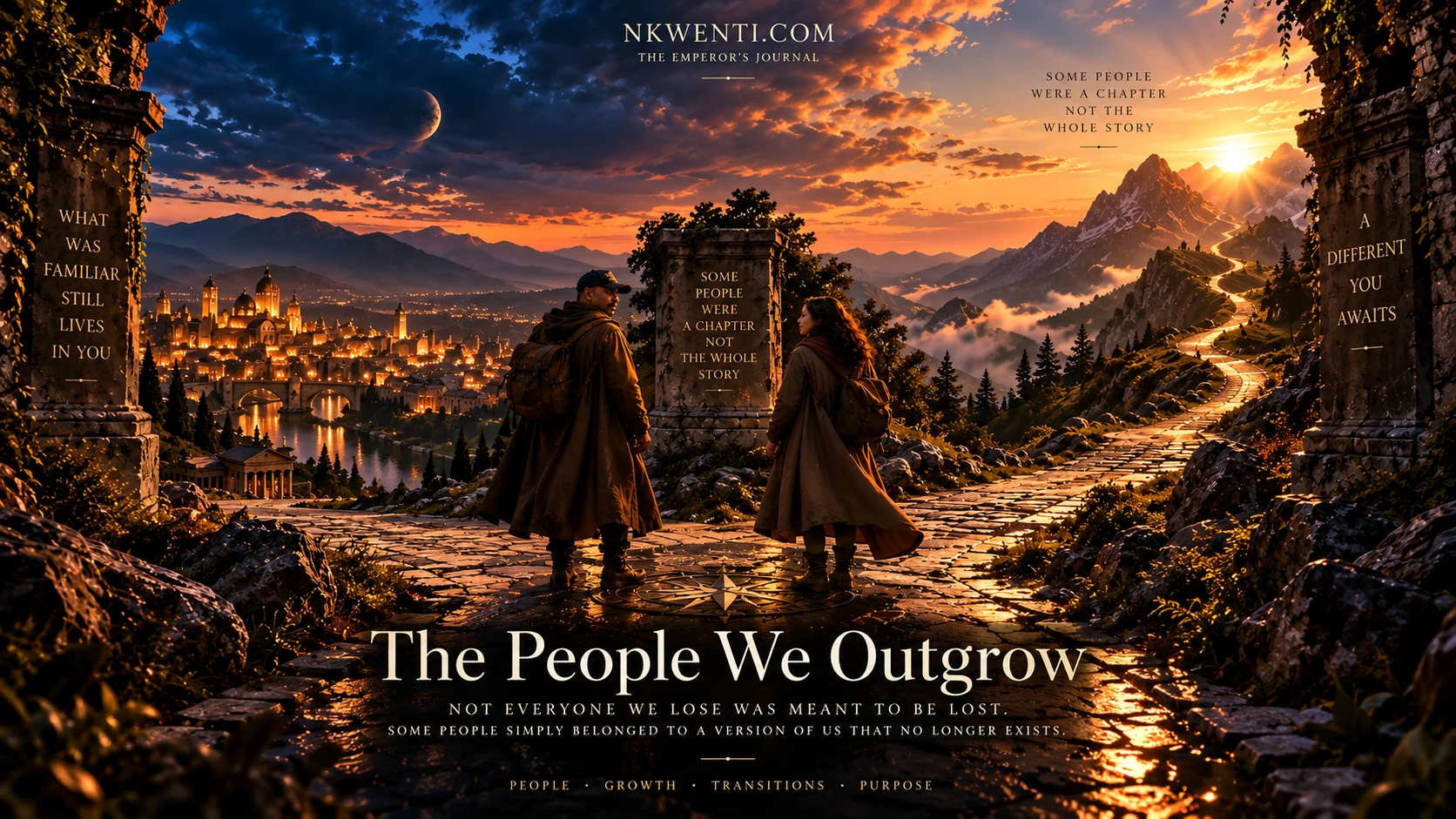
There comes a point in almost every life when you look around and realize that not everyone can come with you.
Not because they failed you.
Not because you failed them.
Not because anyone became cruel, dishonest, or unworthy of love.
Sometimes the explanation is quieter than that.
You are simply no longer the same people who once found each other.
And perhaps that is one of the hardest forms of loss to understand.
Betrayal gives us something to blame.
Conflict gives us something to argue about.
Death gives us something to mourn.
But what do we do with a relationship that ends simply because two lives have begun moving toward different horizons?
There is no villain.
There is no dramatic final scene.
There may not even be a goodbye.
There is only distance.
At first, almost imperceptible.
The conversations become less frequent.
The things that once fascinated both of you no longer hold the same weight.
One person begins asking questions the other no longer wishes to ask.
One begins dreaming beyond the boundaries that once contained both lives.
And somewhere between who you were and who you are becoming, you realize that a person who once felt essential now belongs more naturally to your memories than to your future.
That realization can hurt.
Because some people knew us before the world knew anything about us.
They knew the unfinished version.
The uncertain version.
The version without accomplishments, titles, confidence, clarity, or direction.
They knew the old jokes.
The old fears.
The old neighborhoods.
The old dreams.
They remember chapters of our lives that no new person will ever be able to recreate.
And there is something sacred about that.
History deserves gratitude.
But history does not always require continuation.
We sometimes confuse longevity with destiny.
We assume that because someone has walked beside us for ten years, twenty years, perhaps most of our lives, they must continue walking beside us forever.
But time is evidence that something existed.
It is not proof that it must remain unchanged.
Some relationships are homes.
Others are bridges.
Some people arrive to teach us love.
Some arrive to teach us boundaries.
Some awaken ambition.
Some expose wounds.
Some walk beside us through a season so difficult that we cannot imagine surviving it without them.
And sometimes, after the season has passed, the relationship has completed something neither person understood while living through it.
Completion is not always failure.
A beautiful chapter does not become meaningless because the book continued.
This is where maturity asks something difficult of us:
Can we honor what someone meant to us without demanding that they remain who they were?
Can we love someone without requiring that our paths remain parallel?
Can we remember without returning?
Can we be grateful without becoming guilty for growing?
Because guilt can become one of the invisible chains that keeps people attached to lives they have already outgrown.
You remember what someone did for you.
You remember who stood beside you.
You remember promises made when both of you were younger.
And so when your life begins moving in another direction, part of you whispers:
How can I leave this behind?
But growth is not necessarily abandonment.
Sometimes growth is simply honesty.
Honesty that your values have changed.
Honesty that your priorities have changed.
Honesty that the conversations feeding you now are different from the conversations that fed you then.
Honesty that you can appreciate where you came from without living there forever.
There is a cruelty in pretending.
Pretending to still belong somewhere your spirit has already left.
Pretending to enjoy what no longer moves you.
Pretending not to see the widening distance because acknowledging it might make someone uncomfortable.
That kind of loyalty eventually becomes resentment.
And resentment is a terrible monument to something that was once beautiful.
Better gratitude.
Better honesty.
Better a respectful distance than a dishonest closeness.
You do not honor a relationship by forcing it to survive beyond its truth.
And this does not mean that every difficult relationship should be abandoned.
People disagree.
People change at different speeds.
Friendships pass through quiet seasons.
Love requires patience.
Family requires grace.
Sometimes two people wander apart and later discover each other again with greater wisdom.
Not every distance is an ending.
But neither is every history a command to stay.
Discernment lies in knowing the difference.
Ask yourself:
When I am with this person, am I allowed to become?
Can I speak honestly about what I am building?
Can they celebrate a version of me that no longer needs the role I once played?
Can I celebrate their becoming too?
Or are we both quietly demanding that the other remain recognizable?
Because sometimes we do not actually miss the person.
We miss who we were when we were with them.
We miss being younger.
We miss the old house.
The old city.
The old dreams.
The evenings when life seemed simpler because the future had not yet asked so much of us.
A person can become the doorway through which we remember an entire era.
And when that relationship changes, it can feel as though the era itself is disappearing.
Perhaps that is why letting go can feel so disproportionate.
We are not mourning one person.
We are mourning a world.
But worlds change.
So do we.
The question is not whether change will come.
The question is whether we will meet it with bitterness or wisdom.
I hope wisdom.
I hope that when the road divides, we do not need to destroy the person taking the other path.
I hope we resist the temptation to rewrite beautiful histories simply because they did not become permanent futures.
Someone can have loved you deeply and still not belong in your next chapter.
Someone can have helped save you and still not be called to accompany you forever.
Someone can be good and still no longer be good for the life you are becoming capable of living.
And you can be the person someone else outgrows too.
That truth requires humility.
Perhaps somewhere, someone remembers us with the same tenderness with which we remember another.
Perhaps we were their chapter.
Perhaps we taught something.
Perhaps we wounded something.
Perhaps we helped awaken something.
And perhaps their journey required leaving us behind.
Not every departure is rejection.
Sometimes it is direction.
Look again at the crossroads.
One road leads toward the familiar city.
Its lights are warm.
You know its streets.
You know where the doors are.
You know the language spoken there.
The other road climbs.
You cannot see where it ends.
It disappears into mountains.
There are no guarantees waiting at the summit.
Only possibility.
And perhaps the person standing beside you chooses the city.
Perhaps you choose the mountain.
Neither choice requires hatred.
You can look at each other one final time and silently say:
Thank you.
Thank you for the miles.
Thank you for the laughter.
Thank you for sitting beside me when I did not know what came next.
Thank you for knowing versions of me the world will never meet.
Thank you for being part of the road that brought me here.
And then—
walk.
Carry the wisdom.
Leave the guilt.
Carry the memories.
Leave the obligation.
Carry the love, where love remains.
Leave the need to make permanence the measure of meaning.
Because some people were never meant to be the whole story.
They were a chapter.
And what a beautiful chapter they may have been.
But there are pages ahead that cannot be written while you are endlessly rereading the ones behind you.
The road is dividing.
The horizon is calling.
Bless what was.
Honor what remains.
And have the courage to continue.
Not everyone who mattered yesterday must belong to tomorrow.
Sometimes the most loving thing two people can do—
is release each other into who they are becoming.
— Richard Nkwenti